By Seth Nelson, Mathematics

I have a confession to make. I started out suspicious of WIP. I am a math PhD student, and, if I am being honest, I felt that WIP was about teaching graduate students in English and History about how to grade essays and provide student feedback—things that felt far from mathematics. I am a TA for Introduction to Higher Mathematics, a proof-based course, where students are expected to write up expositions showing why certain mathematical facts must be true. This kind of mathematical writing is critical to the mathematical discipline, but it is bears little resemblance to essays from English classes, and so I questioned the value of my WIP lessons.
I had deeper concerns, however, about the entire philosophy of WIP. To provide some context, every math graduate student must teach a pre-calculus course. We start teaching these courses in our second year, so in our first year we spend a lot of time preparing to teach this class. At face value, I could accept that a writing instructor from an English or History department could provide valuable advice on teaching mathematical writing, but I wondered what on earth writing has to do with pre-calculus?
Now, I freely admit that my position was unfair to WIP’s whole goal. The point of WIP is to prepare TAs to teach writing-based courses! WIP was not designed to help me teach a pre-calculus class. That being said, WIP’s own central tenet is that writing is useful in every skill, even those that have nothing to do with the written word.
The philosophy of WIP is that writing helps students think, reflect, and draw connections between different ideas. In my mind, therefore, pre-calculus was the ultimate litmus test for WIP. If writing can be used in a pre-calculus course, then perhaps those English nut-jobs are onto something, and I should lend them my ear.
These thoughts were all floating in my subconscious one day as I was helping out some students during my office hours. The students were dealing with a particularly troubling question. The challenge was to verify the following inequality:
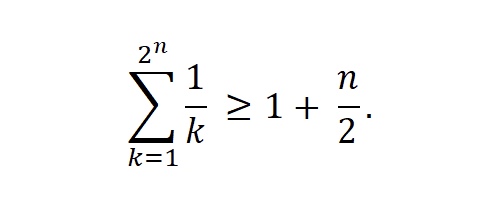
Don’t worry too much about whether or not this makes sense to you. The point is that it made little sense to the students I was working with. The large symbol on the left-hand side is called a sum, and these students had trouble understanding or appreciating what the sum represented, despite doubtlessly computing sums in calculus on their own!
These students had not yet internalized how to work with sums, and they were uncomfortable with the meaning of summation notation. I knew that they had worked with sums before, it is necessary in calculus, but they had trouble connecting that past knowledge to the problem before them right now. I realized in that moment that my students needed to take some time to ruminate on what a sum was. In fact, I devised a question in my head, asking students to write a short paragraph on what sums meant to them, how they thought about them, and how they could do computations with them. Perhaps, if these students spent time thinking and reflecting, they would be more comfortable working with summations.
What a minute… That sounds a whole lot like what WIP is all about! Yes indeed, my wise and sagacious reader, it is what WIP is about. I realized then and there that, though sums—at face value—have nothing to do with writing, writing itself would be a very useful tool for these students. It would help these students be cognizant of what such strange mathematical tools meant, and how they should be treated.
So, if you are a math PhD student, and you are skeptical of this whole WIP business, give it some thought. It might prove more useful than you expect. I certainly will be carrying these lessons into my future as a teacher.